
Shipping heavy equipment like excavators, wheel loaders, or bulldozers across Indonesian islands requires rigorous operational planning. Three core factors determine success: synchronizing sea vessel sailings with highway oversize permits, selecting the maritime vessel that matches destination jetty infrastructure, and executing cargo lashing engineered to withstand open-sea rolling and pitching.
Select sea vessels matching destination jetty conditions
Maritime transport is the lifeline of Indonesian inter-island cargo. Vessel selection must prioritize destination port infrastructure rather than simply choosing the cheapest charter rate.
RORO (Roll-On/Roll-Off) vessels are ideal for major inter-city routes with permanent berths (such as Merak–Bakauheni or Tanjung Perak to Balikpapan/Makassar). Units remain secured on lowbed trailers and drive directly into the enclosed car deck, providing predictable transit times and weather protection.
LCT (Landing Craft Tank) vessels are the primary choice when the project site is located within remote mining or plantation concessions without commercial port facilities. An LCT bow ramp can land directly onto sloping shorelines or temporary jetties, bypassing fragile regional bridges with low weight ratings. For large-scale multi-unit mobilizations alongside structural steel or precast, deck cargo barges offer the most cost-effective bulk capacity.
- RORO vessels: fast, scheduled, enclosed protection, requires permanent berths
- LCT vessels: flexible beach landing or temporary jetty discharge for remote sites
- Deck cargo barges: high-capacity bulk transport for multi-unit fleet mobilizations
Deploy lowbed trailers for units over 15 metric tons
Hauling heavy machinery on standard flatbed tronton trucks is hazardous. Flatbed decks sit 1.4 to 1.6 meters above the road surface. Mounting a 20-ton excavator with a 3-meter cab height results in a total clearance exceeding 4.5 meters, violating highway regulations and creating severe overhead wire entanglement risks.
Standard lowbed trailers feature loading decks positioned 60 to 90 cm above ground. This low profile keeps the center of gravity stable across winding terrain while clearing regional utility lines. For machinery exceeding 35–40 metric tons, multi-axle trailers are required to distribute axle loads and protect asphalt integrity.
- Standard lowbeds: 60–90 cm deck height protects stability and clears overhead wires
- Multi-axle trailers: evenly distribute concentrated weight for 35+ ton units
- Physical dimensional audit: measure highest and widest points before dispatch
Prepare legal documentation and oversize highway permits
Transit delays at weigh stations or seaport gates almost always stem from paperwork omissions. Because heavy machinery represents high-value industrial capital, all regulatory clearances must be finalized prior to transport.
Prepare commercial purchase invoices or ownership certificates to verify clear title. Consignment notes and packing lists must detail chassis serial numbers, engine numbers, and detached attachments. Out-of-gauge and overweight cargo requires official dispensation permits from the transportation department, highway police escorts, and an all-risk marine cargo policy.
- Commercial purchase invoice or registered ownership certificate
- Consignment note and packing list with chassis and engine serial numbers
- Official oversize and overweight highway dispensation permit
- Highway patrol police escort (PJR) routing plan
- Comprehensive all-risk marine transit insurance certificate
Enforce four mandatory cargo lashing standards
Vessel motions in open waters can shift unsecured multi-ton machinery. The Suvarna Trans operations team enforces strict capacity-matched lashing protocols.
Use minimum Grade 70 transport chains paired with ratchet load binders or forged turnbuckles—never textile straps or synthetic rope for units over 5 tons. Rig chains in a four-point diagonal pattern at 30 to 45 degree angles. Lower attachments flush to the deck, engage mechanical swing-lock pins, vent residual hydraulic pressure, and install hardwood wheel chocks with anti-slip rubber friction mats beneath steel tracks.
- Grade 70 transport chains paired with rated turnbuckles and binders
- Crosswise four-point diagonal lashing pattern at 30–45 degree angles
- Hydraulic circuit depressurization and mechanical cab pin engagement
- Hardwood chock blocks and heavy-duty anti-slip rubber friction pads
Demand transparent all-in quotation breakdowns
Be cautious of unusually cheap initial quotes. Low-cost forwarders often quote only the tractor-trailer rental, passing along ferry tickets, police escorts, permits, lashing rigging, and cargo insurance as unexpected additional invoices mid-route.
A transparent all-in commercial proposal includes origin-to-port inland drayage, RORO vessel lane meters or LCT charter fees, inter-provincial oversize permits, lashing hardware and certified rigging labor, all-risk insurance premiums (typically 0.15%–0.25% of insured value), and final delivery to the site pad.
- Inland haulage fees, fuel, driver allowances, and technical crew support
- RORO ferry tariffs by length or dedicated LCT charter fees
- Highway oversize dispensation permits and escort vehicles
- Certified lashing hardware and professional field rigging labor
- Transparent all-risk cargo insurance coverage
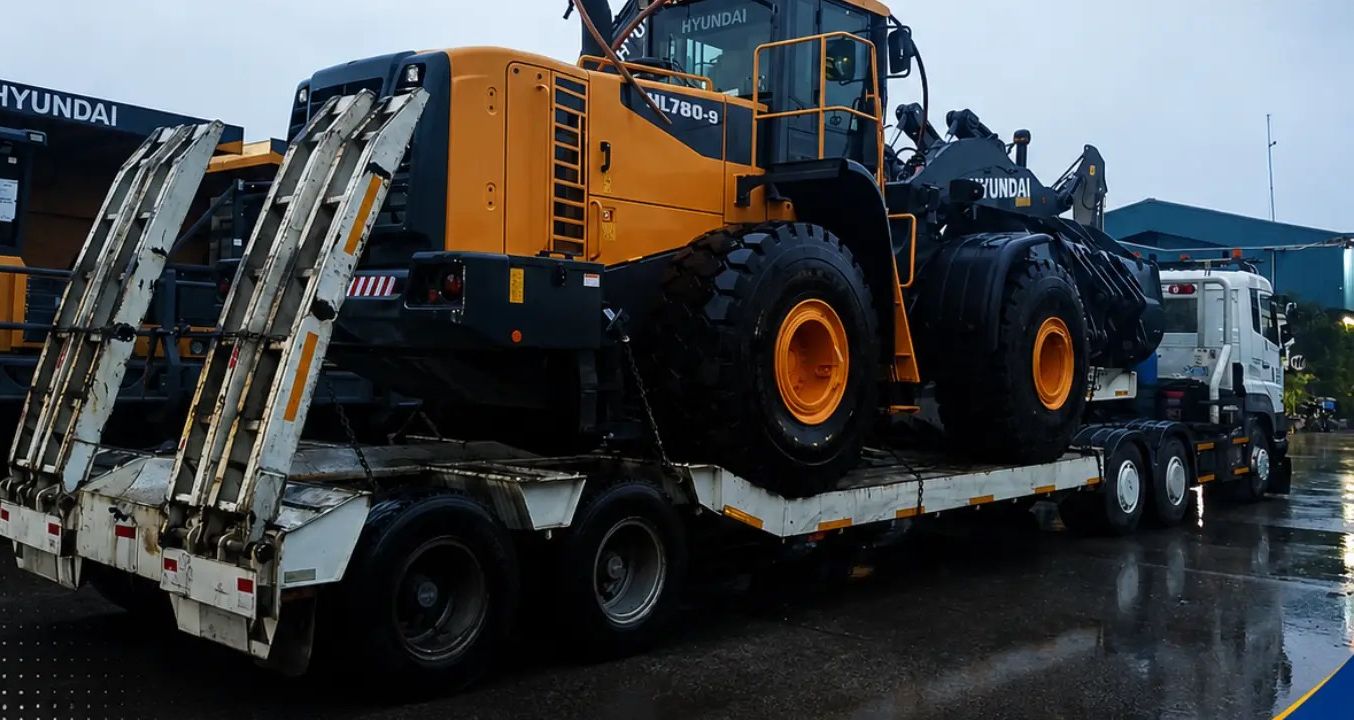
Field notes: Wheel Loader mobilization from Jakarta to Lahat
As an operational example, Suvarna Trans managed the relocation of a 10+ metric ton Wheel Loader from greater Jakarta to an active mining concession in Lahat, South Sumatra. The route covered the Trans-Java tollway, Sunda Strait RORO crossing via Merak–Bakauheni, and the Central Sumatra Highway.
Low overhead utility cables and narrow rural bridges were managed by stowing the front bucket flat against the lowbed deck (keeping total height under 4.2 meters), dispatching an advance reconnaissance escort vehicle to spot low-hanging lines, and re-torquing chain turnbuckles at every transit checkpoint. The machine arrived at the Lahat site within 4 calendar days in ready-to-operate condition.
- Combined route across Trans-Java highway, Sunda Strait RORO, and Central Sumatra corridor
- Front bucket rested flat to maintain total height below 4.2 meters
- Scheduled turnbuckle tension checks at every rest and ferry transit point
- Delivered on schedule within 4 calendar days directly to the site