
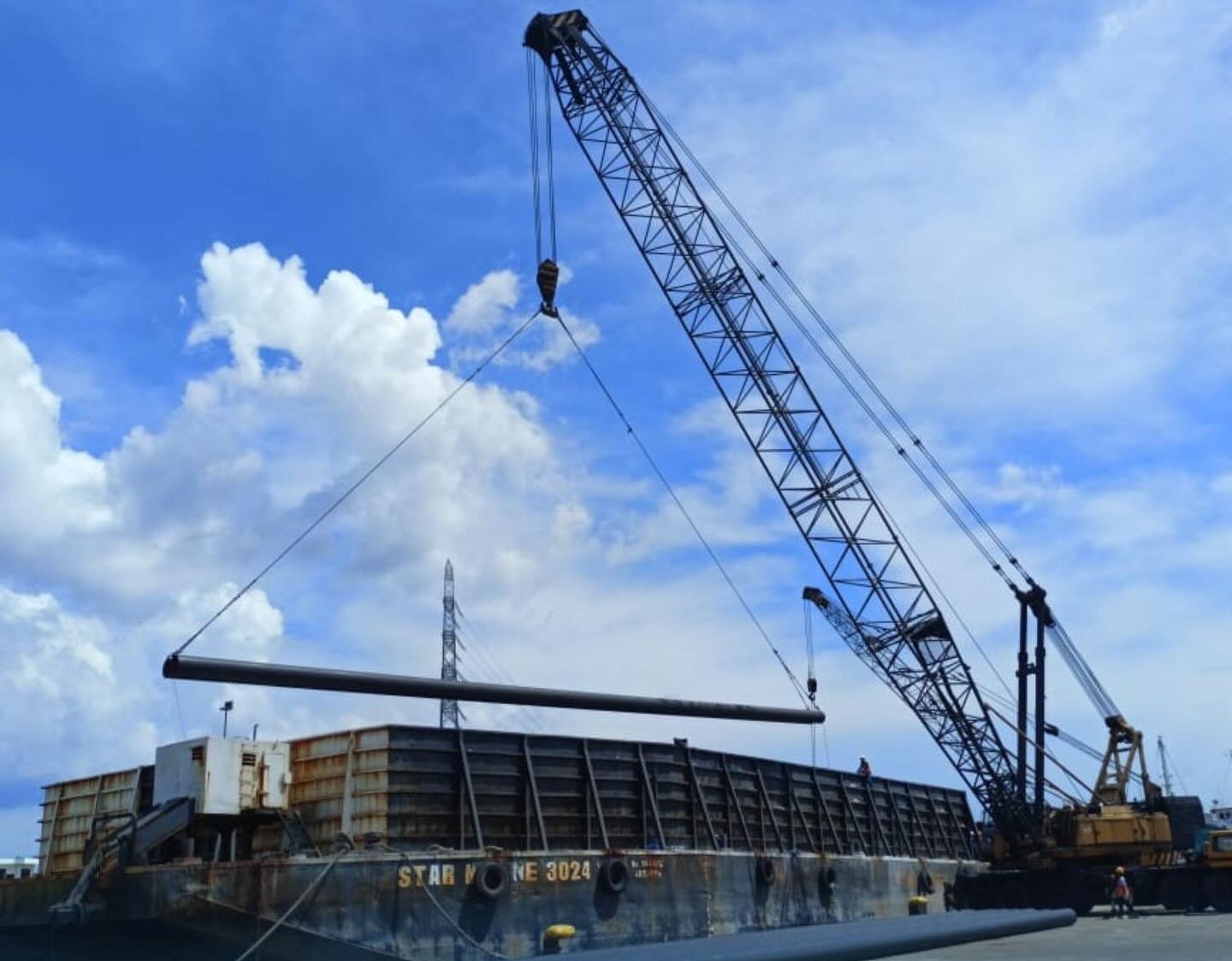
Over-length industrial construction materials—such as precast concrete spun piles and large-diameter steel casing pipes—present severe handling challenges. Spanning 12 to 24 meters, these loads require extendable highway trailers, official oversize permits, and precision multi-tier stowage systems on transport barges.
Managing over-length highway transportation challenges
Loads exceeding 12 meters in length surpass the capacity of standard flatbed tronton trucks. Allowing pipe ends to overhang without engineered support causes dangerous structural deflection and threatens highway safety.
Overland logistics utilizes extendable trailers or modular dolly systems adjusted precisely to the pipe length. Vehicles must be equipped with daytime warning flags, nighttime amber revolving lights, and coordinated police and pilot car escorts.
- Structural deflection prevention: concrete piles risk micro-fractures without balanced dunnage
- Extendable trailers: adjustable deck length accommodating up to 24-meter industrial pipes
- Highway safety escorts: certified pilot vehicles and warning beacons for inter-provincial transit
Multi-tier barge stowage with grooved hardwood dunnage
When stowing cylindrical steel pipes on ocean barges, materials are arranged in structured tiers. Grooved hardwood dunnage and heavy timber wedges are positioned beneath every pipe row to lock round profiles in place.
Wood separation layers prevent steel-on-steel friction that can degrade protective anti-corrosion coatings. Heavy structural steel stanchions are welded along the barge coaming to counteract lateral cargo thrust during heavy sea rolling.
- Grooved dunnage timbers: contoured wood supports lock pipe stacks against roll forces
- Steel perimeter stanchions: reinforced uprights prevent lateral shifting across the deck
- Coating protection: non-marring wood layers preserve epoxy and anti-corrosion surfaces
Engineered wire rope and chain lashing configurations
Securing heavy cylindrical steel demands forged hardware. Suvarna Trans operational standards require minimum 16–19 mm high-tensile wire rope or Grade 70 transport chains paired with forged turnbuckles rated for dynamic marine loads.
Lashing assemblies are anchored to heavy-duty pad eyes welded directly over barge deck frames. Turnbuckle tension is systematically re-torqued following river passage prior to entering open maritime sea lanes.
- High-tensile wire rope: 16+ mm cables paired with drop-forged turnbuckles and ratchet binders
- Deck pad eye welding: lashing points integrated directly into structural vessel framing
- Dynamic tension checks: scheduled re-torquing before navigating open-sea swell environments
Rigging protocols with certified crane spreader bars
Long spun piles and thin-walled steel pipes must never be hoisted via single-point chokers, which introduce extreme bending stresses. Hoisting requires certified engineering spreader beams that maintain vertical (90-degree) sling angles.
Wide synthetic webbing slings must be protected with heavy corner guards to prevent cut-throughs on sharp pipe bevels. All crane operators and riggers must hold active national occupational safety licenses.
- Spreader beams: eliminate horizontal compressive loads during tandem crane lifts
- Corner protectors: protect synthetic slings against sharp pipe bevel edges
- Certified rigging personnel: licensed crane operators and master riggers on every lift
Project case study: Cilegon to Tanah Bumbu pile transport
In a coastal infrastructure project, Suvarna Trans managed the mobilization of fabricated steel piles from Cilegon, Banten, to a port construction site in Tanah Bumbu, South Kalimantan.
The scope encompassed permitted highway lowbed transit to the Banten jetty, harbor crane transfer to a 250-foot deck barge, multi-tier grooved dunnage lashing, and open-sea towing to South Kalimantan, achieving zero-defect delivery without coating damage.
- Multimodal routing: factory lowbed drayage linked to 250-ft deck barge maritime transport
- Zero-defect delivery: hardwood protection preserved anti-corrosion coating integrity
- Coordinated site handover: vessel berthing synchronized with site crane availability